37% of All Email Revenue Comes From 2% of Emails. Mine Were in the Wrong 98%.
Let that number sit for a second.
37% of all email marketing revenue is generated by automated emails — sequences that run on their own, triggered by a single event, working while you sleep, take a day off, or publish absolutely nothing.
And those automated emails? They represent just 2% of total email volume sent. (Omnisend, 2025)
Two percent of the sends. Thirty-seven percent of the revenue.
The other 98% — the newsletters you send when you remember, the one-off broadcasts, the occasional “hey it’s been a while” email — those are doing most of the work and delivering the minority of the results.
I read that statistic and understood it immediately. Then I closed the tab and kept doing exactly what I’d been doing.
No automation. No sequences. An email list that just sat there.
That stayed true until one afternoon when I decided to stop learning about email automation and start just building it — with help.
The Learning Curve Nobody Warns You About
Here’s the thing about email automation tutorials: they’re written for people who are already halfway there.
They assume you know what a “trigger” is. They assume your tool looks like their screenshots. They assume you have a sequence already written and just need to plug it in.
Every time I started, I hit the same wall: somewhere around the third settings panel, I’d lose confidence that what I was building would actually work — and wouldn’t accidentally email my entire list fourteen times on the same day.
So I’d close the tab.
The result: a blog with a growing readership, an email signup form that collected addresses, and no actual system doing anything with those addresses after they arrived.
The first email someone got was nothing. Because nothing was set up.
The Diagram That Made It Click
The difference between manual email marketing and automated email marketing isn’t just convenience. It’s the subscriber experience.
MANUAL EMAIL MARKETING            AUTOMATED EMAIL MARKETING
─────────────────────────         ─────────────────────────────────
Subscriber joins list             Subscriber joins list
        ↓                                  ↓
You remember to send              Trigger fires automatically
        ↓                                  ↓
You write something               Day 0: Welcome email sends
        ↓                                  ↓
You send it                       Day 1: Second email, 24 hrs later
        ↓                                  ↓
Maybe you do it again             Day 2, 3, 4... runs forever

Result: Inconsistent.             Result: Every subscriber gets
Depends entirely on you.          the same nurture experience,
                                  whether you worked that week
                                  or not.
With manual sending, every subscriber’s experience depends on whether you showed up that week. With automation, every subscriber gets the same professional, intentional sequence from Day 0 — regardless of what you’re doing.
That consistency is exactly why automated emails convert 47% better than single one-off emails.
What I Did Instead of Learning It
I stopped trying to figure it out alone and started talking to an AI agent — Happycapy.
Not asking it to explain how automation works. Not requesting a tutorial. I described what I wanted, in plain language:
“I want a 14-email welcome sequence for new subscribers to my WordPress blog. I use FluentCRM. Here are my API credentials. My subscriber list is called Join Us.”
Then I watched it work.
The AI connected to my FluentCRM installation. Created the sequence container. Wrote all 14 emails — subject lines, full body copy, the correct delay between each one. Built the automation funnel. Set the trigger. Walked me through the publishing steps in real time.
When it needed me to do something — click a button, toggle a setting — it told me exactly where to look and what to click.
My total active contribution: granting API access, clicking a handful of buttons, and adding my own product links to two emails at the end because I wanted to do that part myself.
One afternoon. Done.
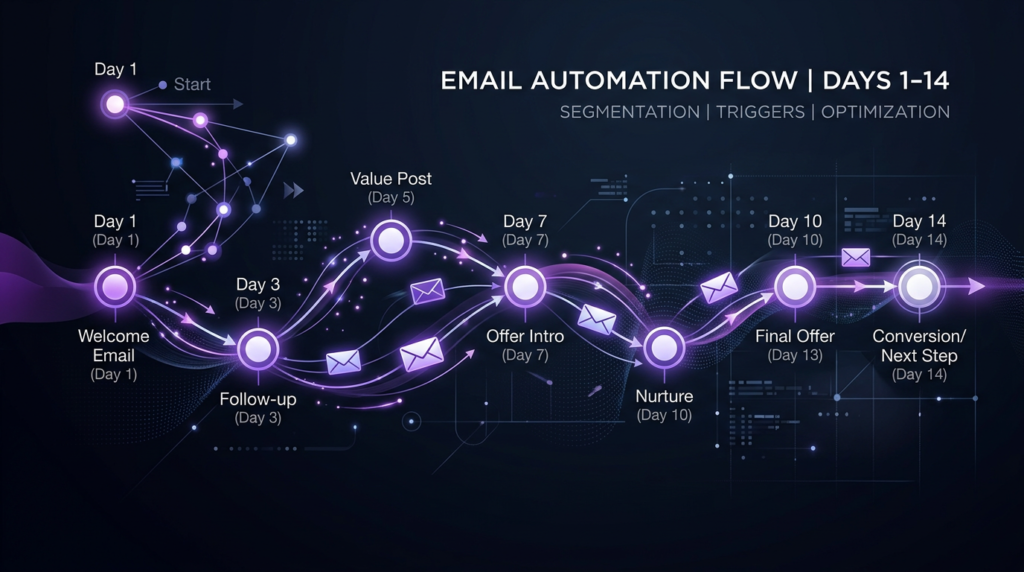
The Architecture of the 14-Day Sequence
Here’s the arc the AI built. This is the overview, not the full playbook — the detailed breakdown is in the guide I’ll mention in a moment.
THE 14-DAY WELCOME SEQUENCE

DAY 0   ──►  You're in. Here's what to expect.
             First impression. Set the tone.

DAY 1   ──►  The real reason most people fail at this.
             Build tension. Make them curious.

DAY 2-5 ──►  The tools, the system, the method.
             Teach. Build trust. Add real value.

DAY 6-7 ──►  Behind the scenes. The honest version.
             Credibility. Soft first mention of offer.

DAY 8   ──►  The full blueprint. ← First real CTA
             Value-heavy email. Link to paid guide.

DAY 9-11 ─►  Objections. Mistakes. Bigger picture.
             Warm up the ones who didn't buy yet.

DAY 12-13 ─► The complete picture. Final offer.
             Close. Thank. Transition to newsletter.
Not 14 random emails. A deliberate 14-day conversation with every new subscriber — whether the first person to join or the ten-thousandth.
The Statistics That Made This Urgent
I already knew email was important. Here’s what I didn’t fully grasp until I looked at the numbers:
Welcome emails average an 83.6% open rate. Not 25%. Not 40%. Eighty-three percent. The best-performing email you will ever send to anyone is the one they get the moment they subscribe — and most bloggers either don’t send one, or send a generic “thanks for subscribing” that wastes it.
1 in 3 people who click a link in an automated email make a purchase. That number is staggering. Automated sequences carry warm, pre-educated subscribers to a link. They’re not cold traffic. They’ve been reading you for days. Of course the conversion rate is higher.
Email delivers $42 for every $1 spent. Social media, paid ads, SEO — nothing else is in the same league for ROI.
Companies using email automation see 451% more qualified leads. Not from sending more emails. From sending the right emails at the right time to the right person.
The infrastructure for all of this — the trigger, the sequence, the automation funnel — is the same thing I now have running on a $103/year tool.
The One Upgrade You Can’t Skip
Here’s the honest part: FluentCRM’s free version doesn’t run automated sequences.
It stores your subscribers. It lets you send manual campaigns. For time-delayed, trigger-based sequences that run automatically — you need FluentCampaign Pro, the paid add-on.
I pushed back on this. The free tier felt like it should be enough. It wasn’t.
The upgrade costs around $103 a year for a single site. One sale from an affiliate link or a digital product more than covers it. But more than the math — without it, the entire system I just described doesn’t exist. You’re back to manual.
Buy the upgrade. Then let the AI build everything in it.
What the AI Does vs. What You Do
This is what confused me most before I actually did it. I thought there would be more to the human side of the equation.
        YOU                         HAPPYCAPY (AI AGENT)
─────────────────────────     ─────────────────────────────────────
Describe what you want    →   Connects to WordPress + FluentCRM

Provide API credentials   →   Creates the Welcome Sequence container

Click "Publish" when      →   Writes all 14 emails with copy
prompted                       + subject lines + delays

Add your own product      →   Sets up the Automation Funnel
links (optional)
                          →   Connects trigger to sequence
Review final emails           (List Applied → Join Us)

                          →   Guides you through each publish step

                          →   System goes live. Runs forever.
The AI doesn’t ask permission to do each individual thing. It works, explains what it did, and asks you to take action only when the action requires you — like toggling a setting or clicking Publish in your WordPress admin.
The rest it handles.
What Surprised Me Most
I expected the hard part to be the tech. It wasn’t.
The part that surprised me was how much I learned just by watching.
Because I saw every step in real time — every API call, every setting, every decision the AI made — I now understand how this system works at a level I never would have reached from a tutorial. I could build a second sequence. I could troubleshoot a trigger that wasn’t firing. I could explain it to someone else.
The AI didn’t replace the learning. It structured it. Gave me a complete picture to understand, rather than a series of abstract steps to memorize.
That’s the part I didn’t see coming. And it’s worth more than the automation itself.
The Part This Post Doesn’t Cover
This post gives you the architecture. The numbers. The honest parts about what it costs and what it involves.
It doesn’t give you:
- The exact 14-email framework with writing prompts for each email
- The step-by-step conversation to have with the AI agent
- How to connect your email capture form to your FluentCRM list
- How to test the sequence before it goes live
- What to do if you already have subscribers and want to enroll them
That’s all in the Email Marketing on Autopilot Guide.
Get the guide and build your sequence →
It’s a PDF walkthrough. Designed to take you from zero automation to a live 14-day sequence in a single session — with the AI doing the heavy lifting and the guide showing you exactly how to direct it.
One Last Thing
Your email list is the only audience asset you fully own.
Social platforms can cut your reach overnight. Google can update its algorithm and wipe out months of traffic. But your list — and the automated system behind it — belongs to you completely.
Most people know this. Most people still don’t have a functioning sequence in place.
The gap between knowing it matters and actually having it built used to be a technical barrier. It used to require skill, or agency budget, or hours you didn’t have.
It doesn’t require any of that anymore. It requires one afternoon and a conversation.
Sources: Omnisend Email Marketing Statistics 2025 · Landbase Email Sequence Statistics 2026 · InboxAlly Email Marketing Data Report 2025 · Tabular Email Marketing Stats (Regularly Updated) · SMTPMaster Email ROI Statistics 2025
Wealth Diagram
Personal finance, passive income, and building wealth on your own terms.