
How to Make Passive Income with a Blog (Starting From Zero)
Most people who want to make passive income online think about YouTube, dropshipping, or crypto. But there’s a quieter path that keeps paying you months — sometimes years — after you do the work. It’s called blogging. And no, not the 2008 kind where you journal about your weekend.

This guide is for complete beginners. No blog, no audience, no budget required. By the end, you’ll know exactly how passive income from a blog works, what steps to take first, and how to avoid the mistake that kills most blogs before they ever earn a dollar.
What Passive Income from a Blog Actually Looks Like
Let’s be honest about one thing upfront: blogging is not truly passive at the start. You’ll put in real work for the first 6–12 months. But here’s what makes it worth it — the content you write today can keep pulling in traffic and income for years without you touching it again.
Here’s how a blog actually makes money in practice:
- Affiliate marketing — You recommend a tool or product, someone buys it through your link, you get a commission. You don’t handle the product, the sale, or the customer.
- Digital products — You create a guide, template, or mini-course once and sell it over and over. No inventory, no shipping, no overhead.
- Email list — Your blog sends people to your email list. That list becomes an audience you own — not rented from an algorithm.
When these three work together, a single blog post can generate affiliate commissions, digital product sales, and new email subscribers every week — while you sleep. That’s the system. Now let’s build it.
Step 1 — Pick a Niche That Has Buyers
Your niche is the topic your blog covers. Picking the wrong one is the fastest way to write great content that earns nothing.
The rule is simple: your niche needs to have problems people pay to solve. Not just problems they complain about. Problems they open their wallet for.
Strong niches for passive income blogs:
- Personal finance (budgeting, debt payoff, investing basics)
- Making money online (side hustles, freelancing, digital products)
- Health and fitness (weight loss, home workouts, nutrition)
- Relationships and self-development
- Software tutorials and productivity tools
You don’t need to be a certified expert. You need to be one step ahead of your reader and willing to share what you know in plain language.
A quick gut check: Can you find affiliate programs in this niche? Are there digital products already selling in this space? If the answer is yes to both, you’ve got a viable niche. Pick it and move on. Overthinking the niche is how people spend three months “researching” instead of publishing.
Step 2 — Set Up Your Blog (Free Options Included)
You have two real options as a beginner: WordPress self-hosted, or an all-in-one platform like Systeme.io.
WordPress is the industry standard. You get full control, thousands of themes, and the best SEO foundation. The tradeoff is that you pay for hosting (usually $3–10/month) and there’s a small learning curve.
Systeme.io has a free plan that gives you a blog, an email list, and the ability to sell digital products — all in one place. It’s not as powerful as WordPress for SEO long-term, but it gets you started with zero monthly cost. If budget is the barrier right now, start here.
- A clean, readable theme (default themes are fine)
- An About page and a Contact page
- An email opt-in form (more on this in Step 4)
- Basic SEO settings — set your page titles, add a meta description to your posts
That’s it. Don’t spend weeks tweaking the design. A plain blog with good content beats a beautiful blog with nothing on it every single time.
Step 3 — Write Content That Attracts the Right Traffic
Not all blog traffic is equal. A thousand readers who are curious is worth less than a hundred readers who are ready to act. The way you get the right traffic is by writing posts that target search intent — meaning, you write content that answers what people are actively typing into Google.
These are called SEO posts, and they’re the engine of passive blog income. Someone searches “how to start a budget spreadsheet,” finds your post, reads it, clicks your affiliate link or signs up for your email list. That process can happen 50 times a day without you doing anything extra.
Here’s how to find the right topics as a beginner:
- Type your niche topic into Google and look at the autocomplete suggestions — those are real searches
- Scroll to the bottom of search results and look at “People also ask” — more real questions
- Use a free tool like Ubersuggest or Google Search Console once your blog is live
Target keywords with clear intent. “Best budgeting apps for beginners” is better than “budgeting” — it’s specific, it implies the reader wants to take action, and it’s easier to rank for than a generic term.
For your first five posts, aim for a mix: two or three “how-to” posts targeting specific search queries, one personal story that builds trust, and one comparison post (like “Tool A vs Tool B”) where you can naturally include affiliate links.
Write at a level your reader can follow. Short paragraphs. Clear headers. Real examples. Skip the jargon. The blogs that rank well and convert readers into buyers are not the ones with the fanciest vocabulary — they’re the ones that actually help people.
Step 4 — Build Your Email List from Day One
This is the step most beginners skip, and it’s the one that costs them the most.
Google can change its algorithm tomorrow and cut your traffic in half. Social media platforms come and go. But your email list is yours. Every subscriber is someone you can reach directly, any time, for free.
Start collecting emails before you think you’re “ready.” Even if you have ten readers a day, build the habit now. When you get to a thousand readers a day, you’ll have a list that’s already warm and engaged.
- A free PDF guide or checklist related to your niche
- A short email course (5 emails, one tip each)
- Early access or updates if you’re building something
You don’t need a complicated funnel. A simple form on your blog saying “Get my free [X] guide — drop your email below” is enough to start. Systeme.io’s free plan includes email marketing built in — it handles the form, the list, and automated follow-up emails without any extra tools.
Once you have an email list, you have leverage. Every time you publish a new post, you email your list. Every time you launch a product or share an affiliate link, you email your list. That’s how a 500-person email list can outperform a 10,000-follower Instagram account in terms of actual sales.
Step 5 — Add Income Streams (Affiliate Links + Digital Products)
Once you have content getting traffic and an email list growing, it’s time to monetize. Two methods work best for beginner bloggers: affiliate marketing and digital products.
Affiliate marketing is the fastest path to your first dollar. Find products or tools your audience already needs, sign up for their affiliate program, and include your link naturally in your posts. Don’t stuff links everywhere — mention them where they actually help the reader, and explain why you recommend them.
Some affiliate programs pay 20–50% commissions on recurring subscriptions. That means one referral can pay you every single month for as long as that person stays subscribed. That’s what real passive income looks like.
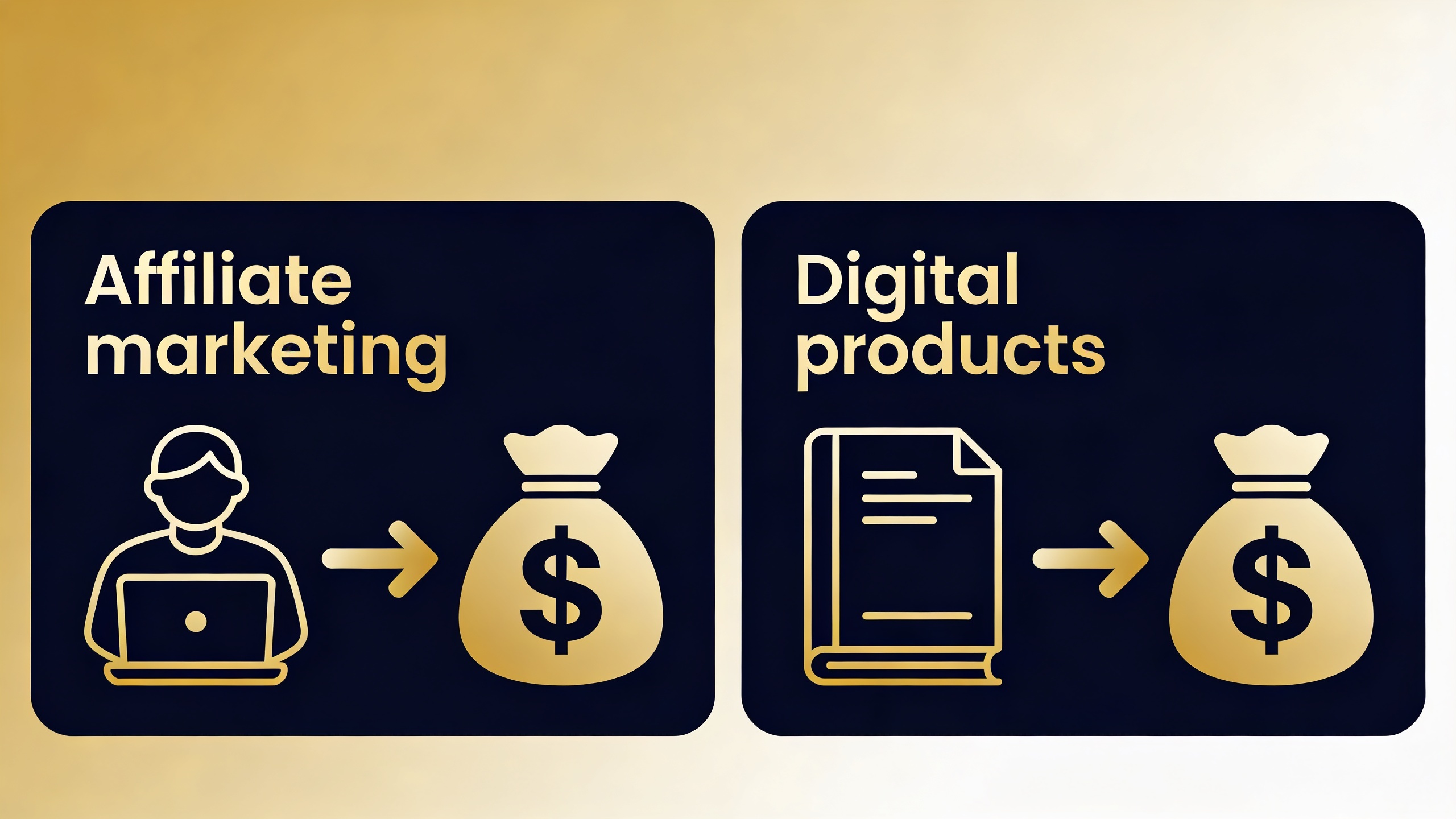
Digital products are where the real leverage comes in. You create something once — an ebook, a template pack, a mini-course — and sell it indefinitely with no extra work per sale. A $27 guide that sells twice a day is $1,600/month in passive income. And it took you one weekend to create.
You don’t need a big audience to sell digital products. You need the right audience — people who found you by searching for exactly the problem your product solves. That’s why SEO content and digital products are such a powerful combination.
Start with one affiliate partnership and one simple product. Don’t try to set up five income streams before you’ve got consistent traffic. Build the engine first, then add fuel.
How Long Does It Actually Take?
Months 1–3: You’re building. Publishing posts, setting up your list, learning SEO. Traffic is low. Income is near zero. This is normal. This is not failure.
Months 4–6: Your posts start getting indexed. Traffic begins to grow. You might see your first affiliate commissions or product sales. Small numbers, but real money.
Months 6–12: If you’ve been consistent, things start compounding. Posts that have been indexed for months start ranking higher. Your email list is growing. Income becomes more predictable.
Year 2 and beyond: The posts you wrote in month 2 are still bringing in traffic. The email list you built in month 4 is still generating sales. You start to understand what passive income actually feels like.
There’s no shortcut to that timeline, but you can slow yourself down by starting too late. The best time to start was six months ago. The second best time is today.
The Biggest Mistake Beginners Make
It’s not writing bad content. It’s not picking the wrong niche. It’s not even skipping SEO.
The biggest mistake is waiting until everything is perfect before publishing.
Beginners spend weeks choosing a blog name. Then weeks choosing a theme. Then weeks writing and rewriting the first post. Then months “planning” the content calendar. And during all of that time, they’re not publishing — which means Google isn’t indexing anything, their list isn’t growing, and their income is exactly zero.
The blogs that win are not the ones with the best design or the most polished strategy. They’re the ones that published consistently while everyone else was still “getting ready.”
You will improve by publishing. You will not improve by planning to publish. Set a deadline — your first post goes live this week. It doesn’t have to be perfect. It has to exist.
Ready to Build the Whole System?
If you want to go beyond this guide and build a complete online income business from scratch — blog, email list, digital products, and passive income streams — I put everything into a step-by-step course called The Playbook.
It’s built specifically for beginners who want to do this anonymously, with no face on camera, no existing audience, and no budget to start. Every module covers exactly one part of the system in the order you need to build it.
You’ve already read how the system works. The next step is building it. Check out The Playbook here and see if it’s right for you.
Wealth Diagram
Personal finance, passive income, and building wealth on your own terms.